

 Exciting News: Partnership Between Obeo and Norasi Team
Obeo and Partner join forces to bring the power of MBSE and Capella to the Thai market.
More informations here: https://www.norasi-team.com/
Obeo และ Norasi Team ได้ร่วมมือกันเพื่อผสานพลังของ MBSE และ Capella สู่ตลาดในประเทศไทย.
ข้อมูลเพิ่มเติมที่นี่ : https://www.norasi-team.com/...
Exciting News: Partnership Between Obeo and Norasi Team
Obeo and Partner join forces to bring the power of MBSE and Capella to the Thai market.
More informations here: https://www.norasi-team.com/
Obeo และ Norasi Team ได้ร่วมมือกันเพื่อผสานพลังของ MBSE และ Capella สู่ตลาดในประเทศไทย.
ข้อมูลเพิ่มเติมที่นี่ : https://www.norasi-team.com/...

News
Exciting News: Partnership Between Obeo and Norasi Team
Obeo and Partner join forces to bring the power of MBSE and Capella to the Thai market.
More informations here: https://www.norasi-team.com/
Obeo และ Norasi Team ได้ร่วมมือกันเพื่อผสานพลังของ MBSE และ Capella สู่ตลาดในประเทศไทย.
ข้อมูลเพิ่มเติมที่นี่ : https://www.norasi-team.com/...
 Exciting News: Partnership Between Obeo and Lotus Technologies, Inc.
In June 2024, OBEO and LOTUS Technologies, Inc. signed a partnership agreement.
Through this partnership, the two companies aim to supply various and effective MBSE solutions, including Capella Add-On products, to the domestic market. These products include “Team for Capella,” specialized in building team collaboration environments, “Publication for Capella,” supporting OSLC compatibility and integration with ALM or RM environments, and “Cloud for Capella,” which establishes an MBSE system modeling work environment in the cloud.
More informations here: https://www.obeosoft.com/en/company/partners/lotus-technologies
2024년 6월에 OBEO와 LOTUS Technologies, Inc.는 파트너십 계약을 체결했습니다.
양사는 이번 파트너쉽 체결을 통해 ARCADIA 방법론 기반의 시스템 아키텍처 모델링 도구인 Capella뿐만 아니라, 팀 협업환경 구축에 특화된 “Team for Capella”, Capella와 OSLC 호환 및 ALM 또는 RM 환경과의 통합 기능을 지원하는 “Publication for Capella”, 그리고 클라우드 환경에서의...
Exciting News: Partnership Between Obeo and Lotus Technologies, Inc.
In June 2024, OBEO and LOTUS Technologies, Inc. signed a partnership agreement.
Through this partnership, the two companies aim to supply various and effective MBSE solutions, including Capella Add-On products, to the domestic market. These products include “Team for Capella,” specialized in building team collaboration environments, “Publication for Capella,” supporting OSLC compatibility and integration with ALM or RM environments, and “Cloud for Capella,” which establishes an MBSE system modeling work environment in the cloud.
More informations here: https://www.obeosoft.com/en/company/partners/lotus-technologies
2024년 6월에 OBEO와 LOTUS Technologies, Inc.는 파트너십 계약을 체결했습니다.
양사는 이번 파트너쉽 체결을 통해 ARCADIA 방법론 기반의 시스템 아키텍처 모델링 도구인 Capella뿐만 아니라, 팀 협업환경 구축에 특화된 “Team for Capella”, Capella와 OSLC 호환 및 ALM 또는 RM 환경과의 통합 기능을 지원하는 “Publication for Capella”, 그리고 클라우드 환경에서의...
 Replay of Capella Webinar - Thursday, September 26th 2024
Integration of Capella with Requirements Management Tools
With the Arcadia method implemented by Capella, engineering is considered through three interrelated activities of equal importance:- Requirements engineering- Need analysis and modelling- Architecture building and validation
The first is generally conducted with a Requirements Management tool (such as Doors or Polarion), while the last two are conducted with Capella.
Using different tools raises questions about efficiently maintaining consistency and alignment between the architecture models and the requirements, and exposing a consistent integrated view of this interrelated data.
During this webinar, you will see how the Publication for Capella add-on enables publishing Capella models on a web server and connecting them with requirements, change requests, test cases, releases, and more, defined in third-party repositories.
This solution breaks down silos...
Replay of Capella Webinar - Thursday, September 26th 2024
Integration of Capella with Requirements Management Tools
With the Arcadia method implemented by Capella, engineering is considered through three interrelated activities of equal importance:- Requirements engineering- Need analysis and modelling- Architecture building and validation
The first is generally conducted with a Requirements Management tool (such as Doors or Polarion), while the last two are conducted with Capella.
Using different tools raises questions about efficiently maintaining consistency and alignment between the architecture models and the requirements, and exposing a consistent integrated view of this interrelated data.
During this webinar, you will see how the Publication for Capella add-on enables publishing Capella models on a web server and connecting them with requirements, change requests, test cases, releases, and more, defined in third-party repositories.
This solution breaks down silos...
 Exciting News: Partnership Between Obeo and Anzen Engineering
We are delighted to announce a groundbreaking partnership between Obeo and Anzen Engineering.
This partnership represents a significant milestone as Obeo and Anzen Engineering come together to advance the field of MBSE. Obeo's expertise and solutions in MBSE, combined with Anzen Engineering's extensive knowledge and experience in safety engineering and systems assurance, create an extraordinary synergy.
For more information, visit: https://www.obeosoft.com/en/company/partners/anzen
...
Exciting News: Partnership Between Obeo and Anzen Engineering
We are delighted to announce a groundbreaking partnership between Obeo and Anzen Engineering.
This partnership represents a significant milestone as Obeo and Anzen Engineering come together to advance the field of MBSE. Obeo's expertise and solutions in MBSE, combined with Anzen Engineering's extensive knowledge and experience in safety engineering and systems assurance, create an extraordinary synergy.
For more information, visit: https://www.obeosoft.com/en/company/partners/anzen
...
 Replay Capella Webinar - July 11th 2024
Optimize Architecture by Generating N2 Design Structure Matrices with DSM4Capella
We propose in this webinar the presentation of our implementation of DSM/N2 matrices applied to Capella Logical Architecture and use it as optimization technique for logical functions to components allocation. Our implementation is proposed as open source in LabsCapella -DSM4Capella.
Presented by:
Sébastien Dubé
Chief Technical Officer and Senior Consultant in Systems Engineering (Samares Engineering)
24 years experience in Systems and Embedded Software Engineering Provide Training, Support, Coaching services on MBSE topics for Capella/ARCADIA and SysML language. Manage the Samares Research activities
Mirna Ojeda
Systems Engineering Consultant (Samares Engineering)
3 years experience in Systems Engineering and MBSESystems Engineering ConsultantProvide Training and support on MBSE (Capella and SysML), develop internal MBSE ...
Replay Capella Webinar - July 11th 2024
Optimize Architecture by Generating N2 Design Structure Matrices with DSM4Capella
We propose in this webinar the presentation of our implementation of DSM/N2 matrices applied to Capella Logical Architecture and use it as optimization technique for logical functions to components allocation. Our implementation is proposed as open source in LabsCapella -DSM4Capella.
Presented by:
Sébastien Dubé
Chief Technical Officer and Senior Consultant in Systems Engineering (Samares Engineering)
24 years experience in Systems and Embedded Software Engineering Provide Training, Support, Coaching services on MBSE topics for Capella/ARCADIA and SysML language. Manage the Samares Research activities
Mirna Ojeda
Systems Engineering Consultant (Samares Engineering)
3 years experience in Systems Engineering and MBSESystems Engineering ConsultantProvide Training and support on MBSE (Capella and SysML), develop internal MBSE ...
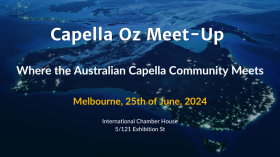 Where the Australian Capella Community Meets
This in-person event is a unique opportunity for Capella users and enthusiasts to gather, exchange ideas, and share their experiences.
This first edition was held at the International Chamber House of Melbourne, the 25th of June 2024. It was such an incredible opportunity to share experiences within the Capella Community and to have the honor of attending a great presentation full of insights :
Romain Horcada (Obeo) made an introduction to Capella,
Tim Carter (KBR) presented a talk name "How-to Model a Logical Architecture with Capella".
...
Where the Australian Capella Community Meets
This in-person event is a unique opportunity for Capella users and enthusiasts to gather, exchange ideas, and share their experiences.
This first edition was held at the International Chamber House of Melbourne, the 25th of June 2024. It was such an incredible opportunity to share experiences within the Capella Community and to have the honor of attending a great presentation full of insights :
Romain Horcada (Obeo) made an introduction to Capella,
Tim Carter (KBR) presented a talk name "How-to Model a Logical Architecture with Capella".
...
 Replay Capella Webinar - June 20th 2024
Working in a Multi-user Mode with Team for Capella
Working with Capella models traditionally involves managing files, which requires careful coordination among team members to handle concurrent work. This often means having to establish strategies for reserving files or resolving conflicts after changes overlap.
By switching to multi-user mode in Capella, you can significantly enhance collaboration among your team of systems architects. This mode helps avoid the tedious management of file differences and reduces the risk of data loss.
Multi-user mode allows team members to work simultaneously and safely on the same model by using:- A shared repository installed on a server to store the Capella model.- An add-on in your Capella workbench, activating a fine-grained locking mechanism that reserves model elements being edited.
These components work in sync to automatically release locks when modifications are saved and make them ...
Replay Capella Webinar - June 20th 2024
Working in a Multi-user Mode with Team for Capella
Working with Capella models traditionally involves managing files, which requires careful coordination among team members to handle concurrent work. This often means having to establish strategies for reserving files or resolving conflicts after changes overlap.
By switching to multi-user mode in Capella, you can significantly enhance collaboration among your team of systems architects. This mode helps avoid the tedious management of file differences and reduces the risk of data loss.
Multi-user mode allows team members to work simultaneously and safely on the same model by using:- A shared repository installed on a server to store the Capella model.- An add-on in your Capella workbench, activating a fine-grained locking mechanism that reserves model elements being edited.
These components work in sync to automatically release locks when modifications are saved and make them ...
 Replay Capella Webinar - June 18th 2024
Unlock the Power of Diagram Creation with Sirius Web
Discover How to Specify Your Own Diagram Editors with Sirius Web!Sirius Web is an open-source project that streamlines the development of web-based graphical modeling applications. It empowers users to create, edit, and visualize their data in customized views.With Sirius Web, you can create various types of views depending on how you need to represent data: forms, diagrams, text, Gantt charts, cards, etc...During this webinar, we focus on a diagrams - a view where data is represented with nodes and edges - which has seen numerous improvements in recent releases.Join us for a guided tour of this Sirius Web feature.
Agenda
The core principles of Sirius Web
Recent changes in Sirius Web following the adoption of ReactFlow
As a studio-maker, how to specify a custom node-based view with Sirius Web?
As an end-user, how to use the s...
Replay Capella Webinar - June 18th 2024
Unlock the Power of Diagram Creation with Sirius Web
Discover How to Specify Your Own Diagram Editors with Sirius Web!Sirius Web is an open-source project that streamlines the development of web-based graphical modeling applications. It empowers users to create, edit, and visualize their data in customized views.With Sirius Web, you can create various types of views depending on how you need to represent data: forms, diagrams, text, Gantt charts, cards, etc...During this webinar, we focus on a diagrams - a view where data is represented with nodes and edges - which has seen numerous improvements in recent releases.Join us for a guided tour of this Sirius Web feature.
Agenda
The core principles of Sirius Web
Recent changes in Sirius Web following the adoption of ReactFlow
As a studio-maker, how to specify a custom node-based view with Sirius Web?
As an end-user, how to use the s...
 Replay Capella Webinar - June 6th 2024
Adopting Model-Based Practices with Capella and TASTE for Student-Developed CubeSat Systems
In today's transforming industry, Model-Based approaches are often seen as an add-on, further complicating the already complex work of systems engineering and software development. But what if it did not have to be this way?
At GU Orbit, we have adopted the Arcadia method exactly to make the process of engineering complex space systems more accessible to undergraduate students. With its multi-level workflow, repetitive activities, and opinionated semantics enforced by the Capella tool, it effectively guides even inexperienced users in the design of rational systems. Additionally, taking advantage of its semantic similarity to the European Space Agency's TASTE toolchain for embedded software development, we have devised an overarching methodology to rigorously bridge the gap between high-level system specifications and low-level component code.
...
Replay Capella Webinar - June 6th 2024
Adopting Model-Based Practices with Capella and TASTE for Student-Developed CubeSat Systems
In today's transforming industry, Model-Based approaches are often seen as an add-on, further complicating the already complex work of systems engineering and software development. But what if it did not have to be this way?
At GU Orbit, we have adopted the Arcadia method exactly to make the process of engineering complex space systems more accessible to undergraduate students. With its multi-level workflow, repetitive activities, and opinionated semantics enforced by the Capella tool, it effectively guides even inexperienced users in the design of rational systems. Additionally, taking advantage of its semantic similarity to the European Space Agency's TASTE toolchain for embedded software development, we have devised an overarching methodology to rigorously bridge the gap between high-level system specifications and low-level component code.
...
 Unleashing Innovation: The Intersection of Enterprise Architecture, Artificial Intelligence and Sustainability
Edinburgh, UK | April 22-25, 2024
The Open Group Summit: Ecosystems Architecture & AI Standards
We will be present at this event on interesting topics with speakers who will address relevant themes. Do not hesitate to contact Jean-Luc Merelli to discuss enterprise architecture in real life at this conference.
Monday, April 22: Ecosystems Architecture & AI Standards
On the first day of the summit, the emphasis will be on addressing the dual challenges presented by the evolving landscape of hyper-enterprise systems and the expansion of AI. It will explore the indispensability and significance of standards in managing the advancements in these systems.
Tuesday, April 23: Sustainability / Enterprise Architecture / EA & AI / Digital Transformation
On the second day of the summit, attention will be directed towards sev...
Unleashing Innovation: The Intersection of Enterprise Architecture, Artificial Intelligence and Sustainability
Edinburgh, UK | April 22-25, 2024
The Open Group Summit: Ecosystems Architecture & AI Standards
We will be present at this event on interesting topics with speakers who will address relevant themes. Do not hesitate to contact Jean-Luc Merelli to discuss enterprise architecture in real life at this conference.
Monday, April 22: Ecosystems Architecture & AI Standards
On the first day of the summit, the emphasis will be on addressing the dual challenges presented by the evolving landscape of hyper-enterprise systems and the expansion of AI. It will explore the indispensability and significance of standards in managing the advancements in these systems.
Tuesday, April 23: Sustainability / Enterprise Architecture / EA & AI / Digital Transformation
On the second day of the summit, attention will be directed towards sev...
Enterprise Architecture Consulting
SlamFlow and Obeo created this partnership to offer a wider range of Enterprise Architecture services and advice based on Obeo SmartEA software (collaboration, data federation, impact analysis of transformations) and the associated support.
SlamFlow offers a range of services to align IT strategy with business goals, as well as a range of services for transformation and cartography programs.
Pour en savoir plus, consultez cette page ! ...
 Systems Engineering Consulting and project execution
LGM promises to provide system designers keys to address the growing complexity of systems and reduce time to market!
In addition to Obeo solutions, our unique approach combines consulting, engineering, data management and digital solutions. This approach, which combines systems engineering, RAMS and digitalisation, brings together more than 450 employees in a collaborative organisation.
To learn more about it, check it out this page!...
Systems Engineering Consulting and project execution
LGM promises to provide system designers keys to address the growing complexity of systems and reduce time to market!
In addition to Obeo solutions, our unique approach combines consulting, engineering, data management and digital solutions. This approach, which combines systems engineering, RAMS and digitalisation, brings together more than 450 employees in a collaborative organisation.
To learn more about it, check it out this page!...
 Replay Sirius webinar - February 29th, 2024
What's New and What's Next? Sirius Latest Technological Advancements and Roadmap
A new year has begun! It's time to take a look back at 2023 and make plans for 2024!
In this webinar, Mélanie Bats presents the major events of 2023, the roadmap for 2024, and the main features included in the latest version of Sirius, including major improvements in the Web version:
- the adoption of React Flow for our diagram rendering,- Gantt, Deck, and Portal new kinds of representation,- reference widgets, custom widgets, and pages in the Form representation,- filters on tree-based representations,- domain definition reusability,- and much more!
Presented by:
Mélanie Bats - CTO at Obeo
In my daily work, I am mainly focused on managing the R&D team, creating products based on our own open source technologies. I am used to work in the development of modeling tools with Sirius like UML Designer. I am committer for the EEF ...
Replay Sirius webinar - February 29th, 2024
What's New and What's Next? Sirius Latest Technological Advancements and Roadmap
A new year has begun! It's time to take a look back at 2023 and make plans for 2024!
In this webinar, Mélanie Bats presents the major events of 2023, the roadmap for 2024, and the main features included in the latest version of Sirius, including major improvements in the Web version:
- the adoption of React Flow for our diagram rendering,- Gantt, Deck, and Portal new kinds of representation,- reference widgets, custom widgets, and pages in the Form representation,- filters on tree-based representations,- domain definition reusability,- and much more!
Presented by:
Mélanie Bats - CTO at Obeo
In my daily work, I am mainly focused on managing the R&D team, creating products based on our own open source technologies. I am used to work in the development of modeling tools with Sirius like UML Designer. I am committer for the EEF ...
 The Annual Systems Engineering Conference is the UK’s premier Systems Engineering event, attracting a wide range of industry, academic, and government professionals.
ASEC UK, organized by INCOSE UK
This year, Capella is a sponsor at ASEC 2023 that takes place at Liverpool on the 21st and the 22nd of November 2023. Samuel ROCHET and Guillaume LANFREY from Obeo are here to answer all your questions about Capella and the professional offer based on Capella....
The Annual Systems Engineering Conference is the UK’s premier Systems Engineering event, attracting a wide range of industry, academic, and government professionals.
ASEC UK, organized by INCOSE UK
This year, Capella is a sponsor at ASEC 2023 that takes place at Liverpool on the 21st and the 22nd of November 2023. Samuel ROCHET and Guillaume LANFREY from Obeo are here to answer all your questions about Capella and the professional offer based on Capella....
 Obeo was at the special event "Requirements Management & Systems Engineering ALM Day" , hosted by Siemens in collaboration with their tech partner, Garantis IT Solutions.
The event was held at in Manufacturing Technology Centre, Coventry, United Kingdom on the 8th of November.
Use Cases with Polarion ALM across different industries (Railway, Automotive, Aerospace...) was presented.
Etienne Juliot (Founder and Vice-President of Obeo) presented a talk "Combine Polarion and Capella to enable a seamlessly integrated view of your system architecture".
For further informations, check out this page!
...
Obeo was at the special event "Requirements Management & Systems Engineering ALM Day" , hosted by Siemens in collaboration with their tech partner, Garantis IT Solutions.
The event was held at in Manufacturing Technology Centre, Coventry, United Kingdom on the 8th of November.
Use Cases with Polarion ALM across different industries (Railway, Automotive, Aerospace...) was presented.
Etienne Juliot (Founder and Vice-President of Obeo) presented a talk "Combine Polarion and Capella to enable a seamlessly integrated view of your system architecture".
For further informations, check out this page!
...
 Let's meet at EclipseCon 2023!
Obeo team members will present several talks during this amazing event, EclipseCon 2023. You will learn a lot about modeling with Sirius and Sirius Web!
Tuesday, October 17th
09:00 AM to 12:00 PM CET | Wilhelm-Krämer-Zimmer Let's Practice Sirius Web: Building Web-based Modeling Tools by Melanie Bats (OBEO), Pierre-Charles David (OBEO), Axel RICHARD (OBEO) 4:50 PM to 5:25 PM CET | Bürgersaal 2 (Sirius + Papyrus) × Web: a new Era for Collaborative Engineering tools by Cedric Brun (OBEO)and Sebastien Gerard (CEA LIST)
Wednesday, October 18th
3:15 PM to 3:50 PM CET | Schubartsaal Shape me Up before you go go! A journey transforming how we build products by Melanie Bats (OBEO)
The leading conference for developers, architects, and open s...
Let's meet at EclipseCon 2023!
Obeo team members will present several talks during this amazing event, EclipseCon 2023. You will learn a lot about modeling with Sirius and Sirius Web!
Tuesday, October 17th
09:00 AM to 12:00 PM CET | Wilhelm-Krämer-Zimmer Let's Practice Sirius Web: Building Web-based Modeling Tools by Melanie Bats (OBEO), Pierre-Charles David (OBEO), Axel RICHARD (OBEO) 4:50 PM to 5:25 PM CET | Bürgersaal 2 (Sirius + Papyrus) × Web: a new Era for Collaborative Engineering tools by Cedric Brun (OBEO)and Sebastien Gerard (CEA LIST)
Wednesday, October 18th
3:15 PM to 3:50 PM CET | Schubartsaal Shape me Up before you go go! A journey transforming how we build products by Melanie Bats (OBEO)
The leading conference for developers, architects, and open s...
 All the videos are available on our Youtube channel!
Capella Days 2023, organized by Obeo and Thales, brings together the community of Capella and Arcadia: creators of this innovative systems engineering solution, providers of Capella add-ons and services, MBSE experts and industrial users.
Check-out the program featuring 12 interesting talks from Capella's feedback on their experience from different engineering domains:
Session 1 with ESA, Thales, CESA, Anzen Engineering
Session 2 with PGM, COMAC, BlueKei Solutions, Siemens DIS
Session 3 with Redwire ,Capgemini Engineering, ManTech, p2m berlin
Session 4 with ITA, Applied Materials, StarFish Medical...
All the videos are available on our Youtube channel!
Capella Days 2023, organized by Obeo and Thales, brings together the community of Capella and Arcadia: creators of this innovative systems engineering solution, providers of Capella add-ons and services, MBSE experts and industrial users.
Check-out the program featuring 12 interesting talks from Capella's feedback on their experience from different engineering domains:
Session 1 with ESA, Thales, CESA, Anzen Engineering
Session 2 with PGM, COMAC, BlueKei Solutions, Siemens DIS
Session 3 with Redwire ,Capgemini Engineering, ManTech, p2m berlin
Session 4 with ITA, Applied Materials, StarFish Medical...
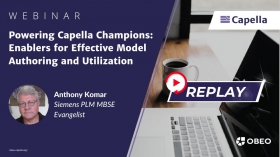 Replay Capella webinar - December 14th 2023
Powering Capella Champions: Enablers for Effective Model Authoring and Utilization
In today's complex systems engineering landscape, Capella has emerged as a powerful tool for model-based systems engineering (MBSE). This presentation explores key enablers for Capella champions to ensure the successful adoption and utilization of Capella within an organization.
Training: Effective training is foundational for developing Capella champions. Tailored programs, from beginner to advanced levels, empower individuals to become proficient in Capella. Strategies for designing training programs aligned with organizational goals are discussed.
Extensible Authoring: Capella's extensible authoring capabilities allow customization to specific domains and engineering practices. Developing custom viewpoints, libraries, and domain-specific extensions is crucial for a seamless fit with organizational requirements.
Accessible Model Content: To max...
Replay Capella webinar - December 14th 2023
Powering Capella Champions: Enablers for Effective Model Authoring and Utilization
In today's complex systems engineering landscape, Capella has emerged as a powerful tool for model-based systems engineering (MBSE). This presentation explores key enablers for Capella champions to ensure the successful adoption and utilization of Capella within an organization.
Training: Effective training is foundational for developing Capella champions. Tailored programs, from beginner to advanced levels, empower individuals to become proficient in Capella. Strategies for designing training programs aligned with organizational goals are discussed.
Extensible Authoring: Capella's extensible authoring capabilities allow customization to specific domains and engineering practices. Developing custom viewpoints, libraries, and domain-specific extensions is crucial for a seamless fit with organizational requirements.
Accessible Model Content: To max...
 Press Release
Paris and Nantes, France - October 10, 2023
Shaping the Future of Model-Based Engineering
CEA-List and Obeo have initiated a collaboration to share their extensive, long-term experience in developing model-based software to serve a long-term vision for the web-based engineering tools of the future. The outcome will be multi-enterprise collaborative solutions, offering an augmented user experience and supporting emerging standards, like SysMLv2.
In many industrial sectors, customers are requesting increasingly connected products. They also have rising expectations concerning safety, sustainability, and cost-effectiveness. Meeting these demands necessitates an exceptionally modular and multidisciplinary approach, resulting in high complexity.
For many years, model-based engineering, which leverages abstraction, computation and visualization, has demonstrated its ability to address this com...
Press Release
Paris and Nantes, France - October 10, 2023
Shaping the Future of Model-Based Engineering
CEA-List and Obeo have initiated a collaboration to share their extensive, long-term experience in developing model-based software to serve a long-term vision for the web-based engineering tools of the future. The outcome will be multi-enterprise collaborative solutions, offering an augmented user experience and supporting emerging standards, like SysMLv2.
In many industrial sectors, customers are requesting increasingly connected products. They also have rising expectations concerning safety, sustainability, and cost-effectiveness. Meeting these demands necessitates an exceptionally modular and multidisciplinary approach, resulting in high complexity.
For many years, model-based engineering, which leverages abstraction, computation and visualization, has demonstrated its ability to address this com...
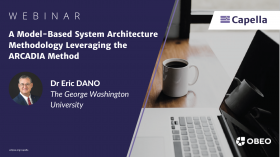 Watch the replay of the Capella Webinar of October 5th 2023!
A Model Based System Architecture Methodology Leveraging the ARCADIA Method
System Architecture, its derived requirements and systems analysis performed, are often attributed to defining 70% of the cost and capabilities of a system. However, after nearly two decades of Model Based Systems Engineering (MBSE), there is a lack of architecture focused methodologies and tools to aid programs in creating a robust, transdisciplinary system architecture.
One notable exception is the Thales developed Architecture Analysis and Design Integrated Approach (ARCADIA) method and associated Capella modeling tool. The ARCADIA Architecture Development Method (ADM) provides instance-based methodologies for each ADM step with rich viewpoints and views to ensure a robust architecture is obtained. As the goal of the proposed methodology is to rapidly create a robust, transdisciplinary system architecture, ARCADIA was selected for its ...
Watch the replay of the Capella Webinar of October 5th 2023!
A Model Based System Architecture Methodology Leveraging the ARCADIA Method
System Architecture, its derived requirements and systems analysis performed, are often attributed to defining 70% of the cost and capabilities of a system. However, after nearly two decades of Model Based Systems Engineering (MBSE), there is a lack of architecture focused methodologies and tools to aid programs in creating a robust, transdisciplinary system architecture.
One notable exception is the Thales developed Architecture Analysis and Design Integrated Approach (ARCADIA) method and associated Capella modeling tool. The ARCADIA Architecture Development Method (ADM) provides instance-based methodologies for each ADM step with rich viewpoints and views to ensure a robust architecture is obtained. As the goal of the proposed methodology is to rapidly create a robust, transdisciplinary system architecture, ARCADIA was selected for its ...